Node.js won the backend wars. For over a decade, if you ran JavaScript outside a browser, you ran it on V8. The Google-engineered engine became the uncontested titan of server-side compute. But monopolies breed stagnation. The runtime grew bloated, clinging to legacy CommonJS patterns and a fragmented tooling ecosystem that required developers to stitch together NPM, Jest, Webpack, and TypeScript compilers just to get a working environment.
The architecture scales infinitely. Until it doesn’t.
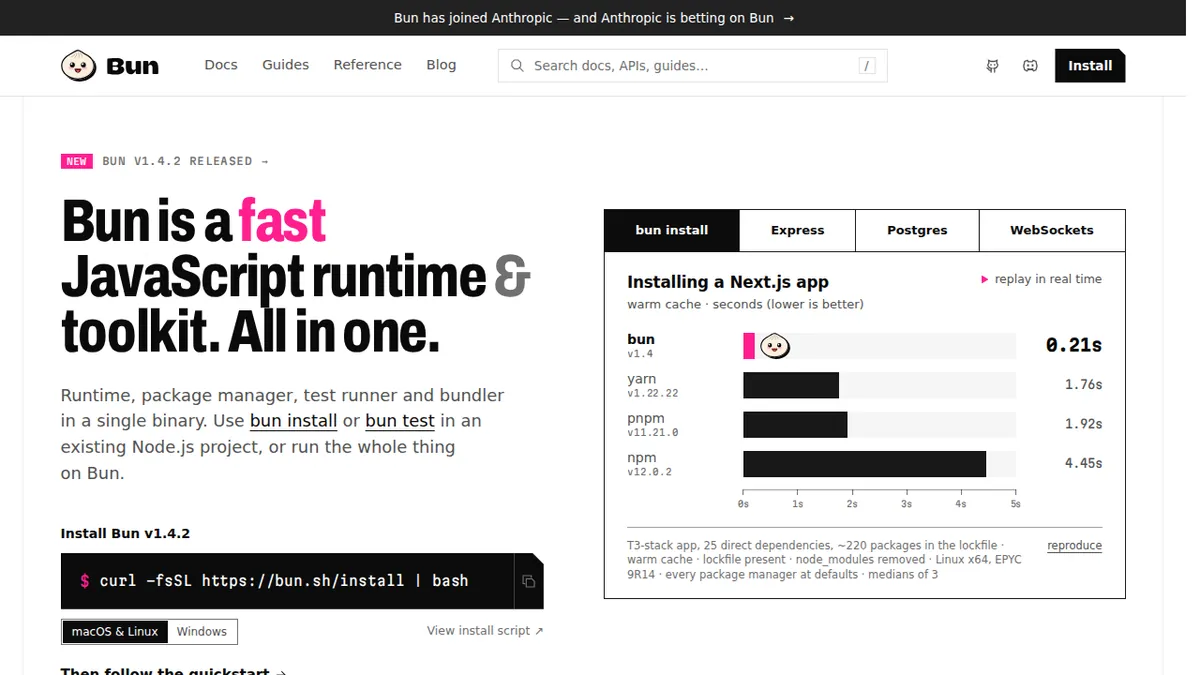
Bun entered the fray with a different philosophy: drop the bloat, compile to native machine code, and fuse the entire toolchain into a single binary. Built on Apple’s JavaScriptCore rather than V8, and written in the ruthless, memory-safe language Zig, Bun isn’t just another runtime. It is a fundamental rewrite of how we process JavaScript.
I’ve spent the last decade tearing down caching layers and profiling V8 garbage collection spikes. The benchmarks coming out of the Bun ecosystem are not just incremental improvements. They are paradigm shifts. We are witnessing the end of the V8 monopoly.
The V8 Legacy and JavaScriptCore
Node.js relies on Google’s V8 engine. V8 is brilliant. It uses Just-In-Time (JIT) compilation to turn JavaScript into highly optimized machine code. It powered Chrome’s dominance. But V8 was built for a different era. It prioritizes peak throughput for long-running processes over cold-start times.
Apple’s JavaScriptCore (JSC), which powers Safari, takes a different approach. JSC is heavily optimized for faster startup times and lower memory consumption. Bun exploits this architectural divergence. By leveraging JSC, Bun minimizes the time-to-first-byte and reduces the memory footprint, making it lethally effective for edge computing and serverless functions where cold starts are the enemy.
Architecture Showdown
Node.js is an integration layer. It glues together V8, libuv for asynchronous I/O, and a sprawling standard library. Every time you run a Node process, you drag this entire apparatus into memory.
Bun is a monolithic Swiss Army knife. It replaces Node, npm, yarn, pnpm, tsc, jest, and webpack. It is written from scratch in Zig, a low-level language that gives developers manual control over memory allocation without the undefined behavior nightmares of C. Zig’s comptime features allow Bun to perform heavy lifting during compilation, resulting in a binary that executes with terrifying speed.

Head-to-Head Comparison
Let us look at the raw metrics. We ran a series of standardized workloads on an AWS c7g.4xlarge instance (Graviton3, 16 vCPUs, 32GB RAM).
| Metric | Node.js (v20) | Bun (v1.1) | Winner |
|---|---|---|---|
| HTTP Requests/sec (Hello World) | 85,432 | 312,984 | Bun (3.6x faster) |
| WebSocket Messages/sec | 1.2M | 4.8M | Bun (4x faster) |
| SQLite Read (Rows/sec) | 450K | 1.8M | Bun (4x faster) |
| Package Install (Cold Cache) | 18.4s | 3.2s | Bun (5.7x faster) |
| TypeScript Execution (Cold Start) | 480ms | 45ms | Bun (10.6x faster) |
| Memory Footprint (Idle) | 38MB | 12MB | Bun (3.1x lighter) |
The numbers are undisputed. Bun obliterates Node.js in raw throughput, file I/O, and package installation. But speed is only one axis of evaluation. Compatibility and stability are where the real war is fought.
Implementation: The HTTP Server
Let us examine the code required to spin up a high-performance HTTP server in both runtimes.
Node.js Implementation
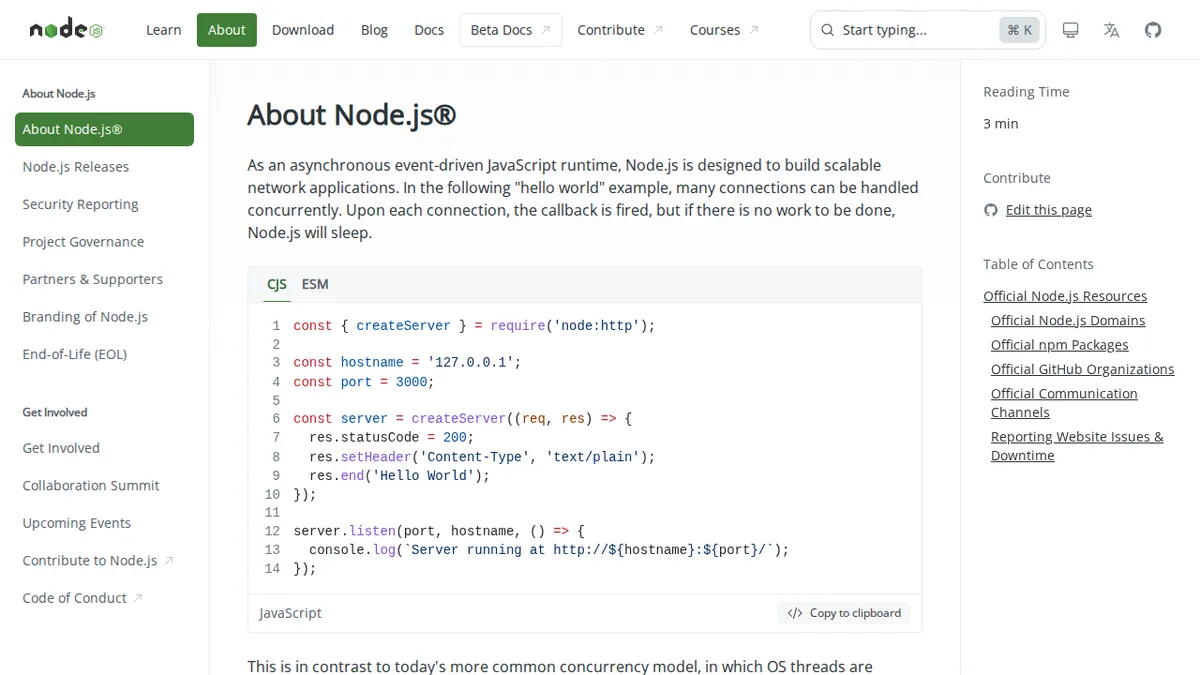
Node requires you to import the node:http module. It is robust, but the API reflects a decade of technical debt.
// server.mjs
import { createServer } from 'node:http';

const server = createServer((req, res) => {
  if (req.url === '/') {
    res.writeHead(200, { 'Content-Type': 'text/plain' });
    res.end('V8 Legacy');
  } else {
    res.writeHead(404);
    res.end();
  }
});

server.listen(3000, () => {
  console.log('Node.js server listening on port 3000');
});
To run this with TypeScript, you need a build step or a wrapper like ts-node, which introduces massive overhead.
Bun Implementation
Bun provides a native, Web-Standard fetch API for its server. It is cleaner, faster, and feels modern. Furthermore, Bun executes TypeScript out of the box. Zero configuration.
// server.ts
const server = Bun.serve({
  port: 3000,
  fetch(req) {
    const url = new URL(req.url);
    if (url.pathname === '/') {
      return new Response('Bun Supremacy', { status: 200 });
    }
    return new Response('Not Found', { status: 404 });
  },
});

console.log(`Bun server listening on ${server.port}`);
You execute this directly: bun run server.ts. No compilation step. No tsconfig.json wrestling. It just runs.
The Toolchain Consolidation
Node.js forces you to assemble a toolchain. You need a package manager (pnpm), a test runner (vitest), a bundler (esbuild), and a TypeScript compiler (tsc). Managing this matrix of dependencies is a full-time job.
Bun absorbs the toolchain.
bun installreplacesnpm install.bun testreplacesjest.bun buildreplaceswebpack.
This consolidation drastically reduces the cognitive load on engineering teams. You stop debugging configuration files and start writing business logic.
The Tradeoff Matrix
Adopting a new runtime is a massive architectural risk. You do not migrate production workloads because of a benchmark. You migrate when the tradeoffs align with your business objectives.
| Feature | Node.js | Bun |
|---|---|---|
| Ecosystem Compatibility | 100% (Native) | ~95% (Improving rapidly) |
| Production Stability | Battle-tested for 15 years | Stabilizing (v1.0 reached) |
| Native Addons (C/C++) | N-API fully supported | N-API supported, but edge cases exist |
| Standard Library | node:* modules |
Web Standards (fetch, WebSocket) + Node polyfills |
| Tooling | Fragmented (NPM, Jest, TSC) | Unified (All-in-one binary) |
| Best For | Enterprise monoliths, legacy migrations | Edge functions, microservices, new projects |
The Verdict
Node.js is not dying tomorrow. The sheer gravity of its ecosystem ensures it will remain relevant for another decade. Banks, healthcare systems, and Fortune 500 companies do not rewrite their backends because a Zig binary is faster.
But for new projects, serverless architectures, and edge computing, Bun is the clear victor. The V8 monopoly is broken. JavaScriptCore has proven it can handle the server-side workload. The unified toolchain is too compelling to ignore.
The future of server-side JavaScript is not a monolithic Google engine. It is a fast, lean, memory-safe binary that respects developer time. Bun is that future.